
Mass flowmeters | Mass flow controllers
A mass flow meter is an instrument that measures the flow of a gas or liquid in terms of mass per unit time, rather than just volume per unit time (as a standard volumetric flow meter does). Mass flow measurement is important in processes where you want to know exactly how much matter (not just volume) is flowing, as density can vary with temperature, pressure and composition. Combined with a control valve, you get a mass flow controller (MFC)

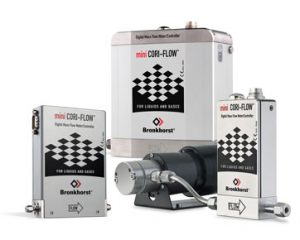
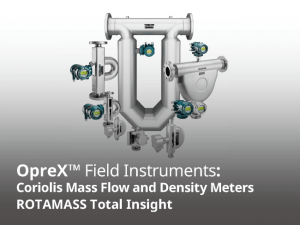
More information
Coriolis mass flow meter - How does it work?
A Coriolis meter often consists of one or two thin tubes through which the liquid or gas flows, and these tubes are set into a controlled vibration, usually by an oscillator. As a medium flows through the vibrating tubes, a Coriolis force is created that twists or bends the tubes slightly depending on the mass flow rate.
By measuring the difference in phase (time shift) between different points on the vibrating tubes, the instrument can determine the magnitude of the Coriolis force - the greater the mass flow, the greater the twist or phase shift. From the measurement of this phase shift, the mass flow rate is calculated directly, and the meter can simultaneously calculate the density by measuring the resonant frequency of the pipe, since a heavier liquid or gas affects the resonance differently than a lighter one.
Advantages
Coriolis meters offer high accuracy for both mass flow and density, are largely independent of temperature and pressure (do not need to compensate for changes in density) and provide multifunctional measurements in terms of mass flow, density and temperature.
- High accuracy for both mass flow and density.
- Independent of temperature and pressure to a large extent (does not need to compensate for changes in density).
- Multifunction: Provides both mass flow, density and temperature.
Disadvantages
They are more expensive than simpler flowmeters and can be sensitive to ambient vibrations, sometimes requiring some damping or a robust installation.
- Higher cost than simpler flowmeters.
- Sensitive to environmental vibrations, sometimes requiring some damping or robust installation.
Thermal (thermal dispersion) mass flow meter - How does it work?
A thermal mass flow meter usually has one or two sensor elements, such as platinum sensors, which are heated to a known temperature. When gas - or in some cases liquid - flows over the heated sensor, the sensor cools down, and the cooling is proportional to the mass flow rate because it is the mass of medium that carries away the heat, not the volume.
Measuring how much current or power is required to keep the sensor at a constant temperature, or how much the temperature drops at constant power, gives a measure of mass flow. Since the measurement is based on heat transfer, calibration is required for the specific medium; different gases have different thermal conductivities and heat capacities, and for multi-component gas mixtures more advanced calibration may be needed.
Advantages
The mechanical design is relatively simple with no moving parts in the flow sensor itself, it is well suited for dry, clean gases in laboratory and process applications and it provides fast response to rapid flow changes.
- Relatively simple mechanical design (no moving parts in the flow sensor itself).
- Good for dry, clean gases, for example in laboratories
- Fast response to rapid changes in flow.
Disadvantages
The thermal mass flow meter is sensitive to changes in gas composition; if the gas mixture changes, the measurement result may be affected. It can also be affected by fouling, as coatings or particles alter the heat transfer of the sensor. For liquids, the technology is less common, although some specialised versions are available.
- Sensitive to changes in the composition of the gas (if the gas mixture is changed, the result may be affected).
- May be sensitive to soiling (coatings or particles may alter the heat transfer of the sensor).
- Less common for liquids (some specialised versions available).
Frequently asked questions about mass flow meters
What is a mass flow controller?
A mass flow meter combined or built together with a control valve is often called a mass flow controller, or MFC. The advantage of an assembled mass flow controller is fast control with little delay and often a compact, space-saving solution.
How does a Coriolis meter work?
Vibrating pipes are affected by Coriolis force when the medium flows. Measuring phase difference in the tubes gives direct mass flow and also density via resonant frequency.
What are the pros and cons of Coriolis?
Advantages: very high accuracy, largely independent of temperature/pressure, also measures density and temperature. Disadvantages: more expensive and sensitive to ambient vibrations.
How does a thermal mass flow meter work - and limitations?
Heated sensors are cooled by the flow; power or temperature change produces mass flow and requires media-specific calibration. Limitations: sensitive to changing gas composition and fouling; less common for liquids.